
Manufacturing modelling supports plans to produce 36 floating offshore wind foundations a year in Scotland
Background
Slipform Engineering specialises in slipforming, a construction technique that uses continuously moving moulds to create large concrete structures.
The company is now applying this expertise to floating offshore wind. It plans to establish Slip4Wind®, a manufacturing facility at Kishorn in the north-west Highlands, capable of producing up to 36 concrete foundations a year. Together, these could support more than 500 MW of offshore wind capacity annually.
The project was funded by the Offshore Wind Growth Partnership (OWGP) through its SmartStart Manufacturing Programme. The programme helps UK companies develop investment-ready business cases for new or expanded offshore wind manufacturing facilities.
Challenge
At approximately 20,000 tonnes each, floating offshore wind foundations present enormous manufacturing and logistical challenges. Moving structures of this scale during production can be costly and complex.
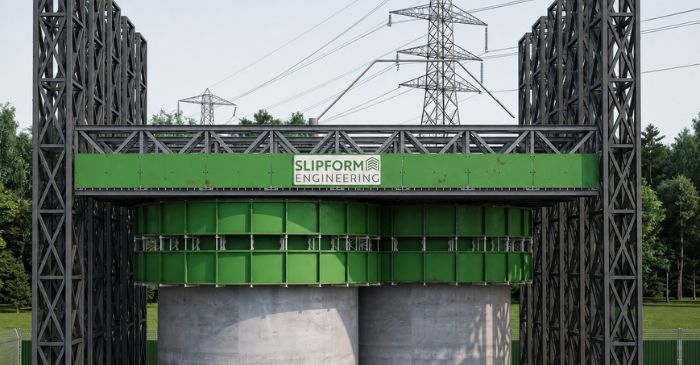
Slipform Engineering has developed a proposed gantry system that allows the foundations to remain in place while manufacturing equipment moves around them. Once complete, they can be transferred directly into the water, reducing handling costs.
Before investing in Slip4Wind® at Kishorn, the company needed to establish whether this approach could deliver its target of 36 foundations a year. This meant understanding the factory's production capacity, operating costs and workforce requirements, while identifying potential bottlenecks.
What did NMIS do?
Through OWGP’s SmartStart Manufacturing Programme, NMIS engineers worked with Slipform Engineering to define the site and manufacturing requirements for Slip4Wind®, using capacity and cost modelling to assess how production at Kishorn could operate.
The team also used discrete event simulation to model how the proposed gantry system would operate under different staffing levels and shift patterns. This helped assess whether the factory could achieve its annual target of 36 concrete floating foundations and identify potential bottlenecks and capacity constraints. The modelling also explored opportunities to improve efficiency through more flexible working arrangements and training workers to perform multiple roles.
NMIS developed a phased plan covering infrastructure, investment, regulatory requirements and workforce development. The findings were presented in a format that Slipform Engineering could use in future discussions with investors and offshore wind developers.
The team also connected the company with Ayrshire College to explore workforce training and multi-skilling opportunities ahead of future production.
Impact
The programme gave Slipform Engineering a clearer understanding of the costs, capacity and workforce requirements for Slip4Wind®, helping the company test its plans before committing to major investment.
The modelling identified opportunities to improve production efficiency, while NMIS' phased development plan provided a roadmap for the next stages of the project.
Work is now well underway at Slipform Engineering’s Hunterston demonstration, research, development and training facility in North Ayrshire, which is scheduled to open in January 2027. The site will allow the company to test a smaller version of its gantry system, trial different concrete materials and develop workforce skills ahead of future production at Kishorn.
If realised, Slip4Wind® could strengthen Scotland's offshore wind supply chain as developers progress projects through the ScotWind pipeline.
“Working with NMIS through the SmartStart Manufacturing Programme has been extremely valuable in helping us test our plans before making the investment. The modelling has given us greater confidence in what we can achieve at Kishorn, while identifying practical improvements that we can incorporate into the factory’s development.
“The support provided by the Offshore Wind Growth Partnership has helped us progress from an initial concept to a credible investment proposition.”
Eamon Hanley, founder and managing director at Slipform Engineering