
Manufacturing blueprint unlocks UK offshore wind opportunity
Background
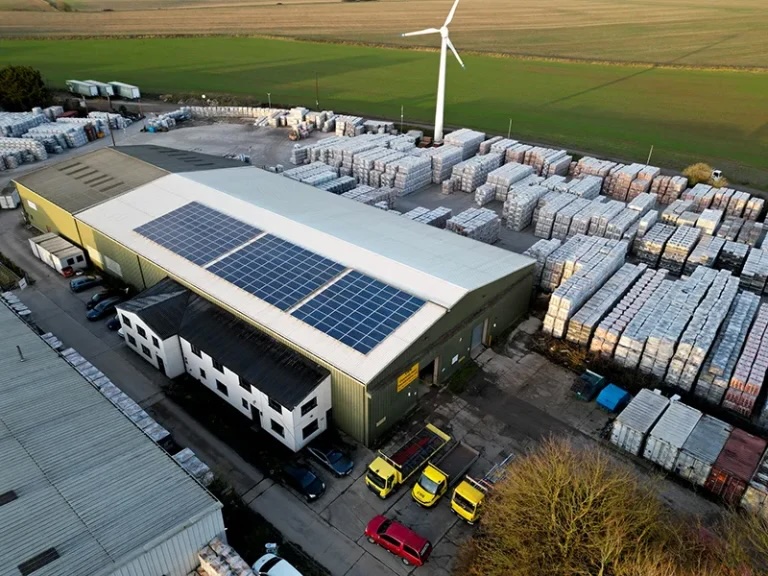
Gabriel Engineering Group Ltd is a Gloucestershire-based engineering and fabrication company with expertise in delivering complex technical solutions across industrial sectors. Expanding into the offshore wind supply chain was a natural fit for the business, building on its existing capabilities to explore opportunities in anchoring and mooring systems – essential infrastructure that secures floating offshore wind turbines to the seabed in deeper water locations.
To support this ambition, the company partnered with the National Manufacturing Institute Scotland (NMIS) through The Crown Estate’s £50 million Supply Chain Accelerator programme. The project aimed to identify a commercially viable manufacturing opportunity and assess how the company could establish an efficient and scalable route to producing offshore wind anchoring and mooring systems within the UK.
Challenge
As a new entrant to the offshore wind market, Gabriel Engineering needed to understand whether large-scale anchoring systems could be manufactured efficiently, competitively and at scale using its existing fabrication expertise.
The company also wanted to explore whether floating wind mooring connection and tensioning technologies developed by world-leading partner company, Bardex® Corporation, could be fabricated using a more efficient manufacturing approach, reducing production costs, while supporting future growth.
Understanding production costs, equipment requirements, environmental impacts and investment needs was critical before progressing towards commercial opportunities in the sector. The company also needed to establish where a future facility could be built, and what infrastructure and site investment that would require.
What did NMIS do?
NMIS worked closely with Gabriel Engineering to assess viable manufacturing routes for drag embedment anchors and associated mooring systems. The team analysed design requirements, materials, labour, equipment and production simulation, mapping a manufacturing route comprising of value-add production steps before developing digital manufacturing models to evaluate potential production scenarios.
Lifecycle assessments and cost models were used to identify key cost drivers and opportunities to improve efficiency and support future scale-up. The analysis provided evidence of the technical, commercial and operational feasibility of establishing a UK manufacturing capability for offshore wind anchoring and mooring systems. NMIS also supported Gabriel Engineering to identify where this future facility could be built.
With the Celtic Sea emerging as one of Europe’s most promising regions for floating offshore wind, the project explored how a UK-based facility could capture this opportunity for local communities rather relying on imported systems. A team from NMIS and Gabriel Engineering visited potential port locations including Milford Haven, Port Talbot, Cardiff and Falmouth, meeting local councils to assess access to skilled labour, availabile land and the infrastructure required to move heavy materials and finished products.
Around ten potential locations were assessed against the manufacturing, production and cost requirements identified through the earlier analysis, narrowing the field to two preferred options for further engagement with local stakeholders and landowners.
Impact
Gabriel Engineering drew on NMIS’ manufacturing expertise to complete a feasibility study that demonstrated a commercially viable approach to manufacturing offshore wind anchoring and mooring systems in the UK.
Building on Bardex's proven BarLatch and BarMoor technologies, the project validated a scalable modular manufacturing approach, identified suitable locations for a future production facility, and provided the evidence now underpinning Gabriel Engineering's and Bardex's future investment and commercial plans.
The modular manufacturing approach offers several advantages:
- Parallel processing through the integration of the BarLatch and BarMoor systems into pre-tested modules before final assembly.
- Reduced manufacturing risk by identifying and resolving technical tolerances at the modular stage.
- Improved supply chain resilience through a more flexible production model.
The study demonstrated how advanced tooling, automation and digitally enabled manufacturing could improve efficiency, reduce operational risk and strengthen commercial viability. It also identified suitable locations for a future manufacturing facility that, if developed, could create up to 40 skilled jobs and further support employment across the regional supply chain.
Project at a glance
✓ Developed a commercially viable UK manufacturing blueprint for offshore wind anchoring and mooring systems
✓ Validated a scalable modular manufacturing approach using Bardex's BarLatch and BarMoor technologies
✓ Assessed around 10 potential sites and identified preferred locations for a future manufacturing facility
✓ Demonstrated the potential to create up to 40 skilled jobs, alongside further employment across the regional supply chain
✓ Provided the evidence underpinning future investment planning and commercial discussions
Jason Simeon, Chief Executive Officer at Gabriel Engineering, said: “Our collaboration with NMIS has been a turning point for Gabriel Engineering. By focusing on a modular process approach, we’ve been able to integrate the high-performance products into a system that is designed for the factory of the future. We have been able to design a better production process that removes the inherent risks associated with large-scale fabrication, enabling us to deliver at the pace required by the offshore wind market.”
“This project has never only been about products – it’s also about people and place. By pinpointing where we can build and the skills we will need, we are laying the groundwork for a facility that creates lasting, high-value jobs and helps regenerate the coastal communities at the heart of the Celtic Sea opportunity."
Ian Finch, Director of Business Development – EMEA at Bardex Corporation, said: “The collaboration with Gabriel Engineering, NMIS, and The Crown Estate has created a blueprint for how we can develop a high-value advanced manufacturing facility for our mooring connectors and related products. This will create long-term UK jobs and a huge potential export market for our proven technologies at the high volumes needed to build gigawatt-scale floating wind projects. We’re excited to work with Gabriel Engineering and The Crown Estate during the next phases of this work.”