
NMIS 5G trial explores future of industrial connectivity in Ayrshire
Background
The National Manufacturing Institute Scotland (NMIS) has partnered with Merck, North Ayrshire Council and Folk Consulting to explore how private 5G mobile networks could support the growing need for secure, high-capacity connectivity in advanced manufacturing environments.
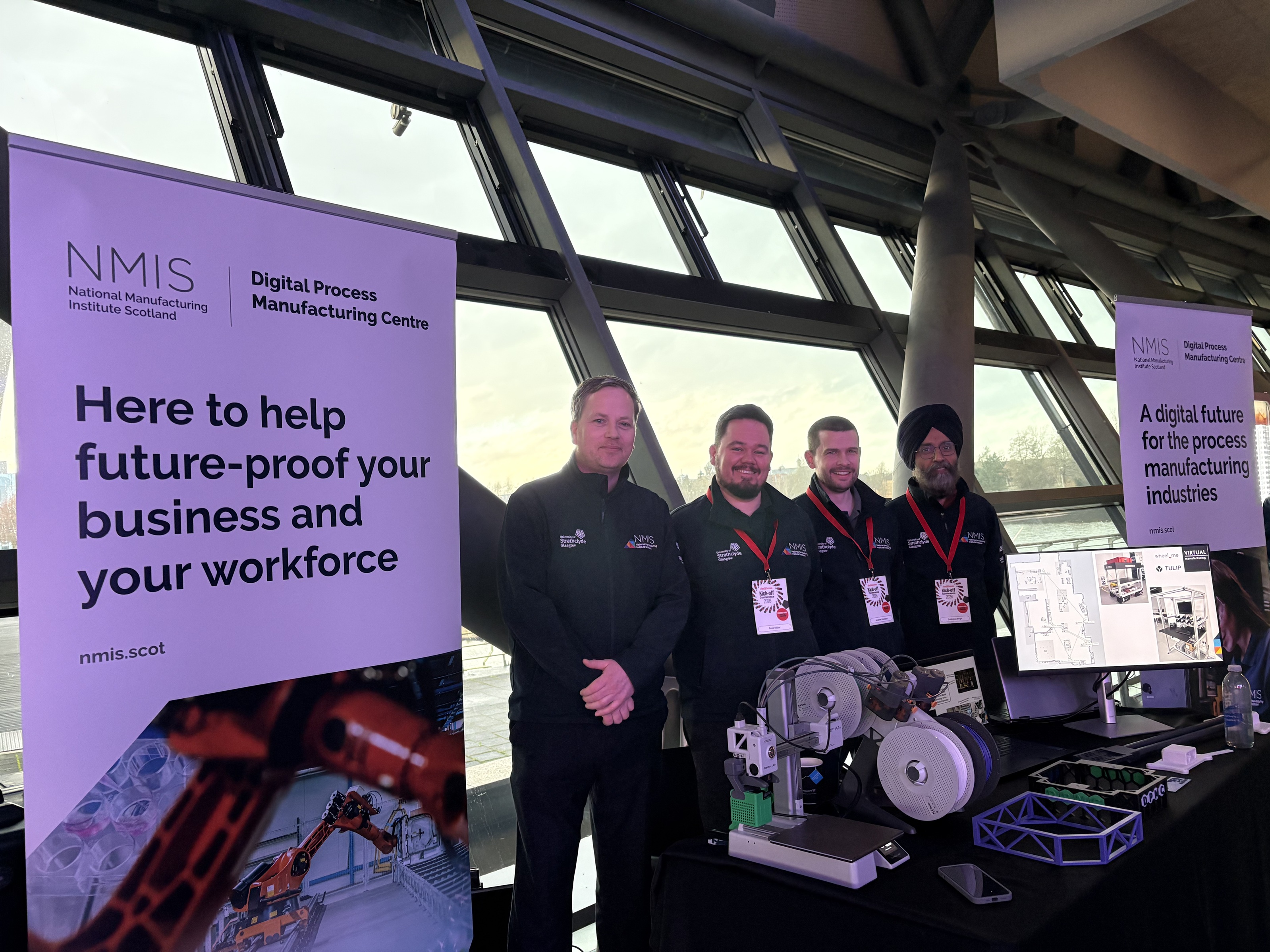
Delivered at NMIS’s Digital Process Manufacturing Centre (DPMC), the project was funded in part by the Department for Science, Innovation and Technology’s 5G Innovation Programme in Ayrshire.
As manufacturers increasingly adopt connected and data-driven production systems, demand for fast, reliable and secure wireless connectivity continues to grow. While many manufacturers already use advanced wireless systems, limitations around capacity, security and scalability could restrict how effectively data is managed at scale. As a result, private 5G mobile networks are increasingly being explored as a potential alternative.
Challenge
Although interest in 5G within manufacturing continues to grow, many organisations still lack clear evidence of how the technology performs in realistic operational settings.
Key challenges included:
- Understanding how private 5G networks perform under manufacturing-style conditions
- Replicating industrial environments without relying on live operational data
- Generating reliable and repeatable performance metrics
- Helping manufacturers benchmark 5G capabilities against existing connectivity systems
- Reducing uncertainty around future adoption and investment
What did NMIS do?
Using a Vodafone-supplied Ericsson 5G mobile network deployed at the DPMC, NMIS developed a simulated manufacturing use case in collaboration with Merck, a global science and technology company.
Based on pumps, fans and control systems commonly found across manufacturing facilities, the simulated plant room environment enabled the team to replicate realistic industrial conditions without relying on live production data.
Working alongside 5G specialists at Folk Consulting, NMIS designed the data generation and transmission approach, validated the flow of information through the network and interpreted the results to ensure the testing reflected a realistic industrial deployment.
The system was then tested under progressively increasing network loads to assess performance, scalability and reliability within a controlled factory-like environment.
Impact
The trial demonstrated that the private 5G network could scale from a baseline of 4 megabits per second (Mbps) to an average throughput of more than 97 Mbps, with peak speeds exceeding 100 Mbps. In practical terms, the findings suggest the network could support around 390 simulated plant room environments operating simultaneously, demonstrating strong capacity for future industrial applications.
The project provided practical insight into how private 5G networks perform under manufacturing-style conditions and helped reduce uncertainty around adoption for industry.
It also established a repeatable testing methodology that manufacturers could use to benchmark private 5G performance against existing connectivity systems before committing to future investment.
In addition, the collaboration reinforced the role of the DPMC as a practical test environment where manufacturers can explore emerging digital technologies and assess their suitability before large-scale deployment.
Louise Kirk, director (regional economy) at North Ayrshire Council, said: “This project demonstrates what can be achieved when industry and the public sector work together with a shared purpose. By creating an environment where businesses can test and explore technologies like 5G in a controlled, practical way, we can build confidence locally and attract the investment needed to support the infrastructure required for the next generation of manufacturers.”